

Stakeholder engagement isn't a communications tool. It's a trust tool.
Imagine an organisation under pressure.
Leadership has made some hard calls. The decisions were sound - financially, strategically, legally. The board was briefed. The lawyers were satisfied. The numbers stacked up.
But nobody told the people who mattered most. Not properly. Not in a way that made them feel seen or considered, that invited their questions, acknowledged their concerns, or gave them a genuine reason to stay invested in the organisation's future.
So they disengaged ... and they talked on the way out.
What followed wasn't a governance crisis or a financial crisis. It was a trust crisis, and trust crises are the hardest to recover from because by the time you know you're in one, the damage is already done.
I've watched this pattern play out more times than I'd like across universities, industry bodies, and professional services firms. The common thread is never malice, it's assumption. Leadership assumed that because the decision was right, the communication could wait, that stakeholders would come around once the dust settled, that a well-worded update would smooth things over when the time felt right.
It didn't, and it rarely does.
Here's what two decades of stakeholder engagement work has taught me: people don't need to agree with your decisions. They need to feel respected by the process that led to them. That's the difference between a stakeholder who advocates for you when things get difficult and one who becomes your most credible critic.
Engagement is not the announcement you make after the decision. It's the relationship you build long before you ever need to make one.
Three things you can do right now to protect that relationship:
1. Map who matters before the pressure arrives. Not just your formal stakeholders, your regulators, funders and peak bodies, but the informal ones too. The respected voice in the room who others look to. The long-serving member whose endorsement carries real weight. Know who they are before you need them, because once you need them it's too late to start building the relationship.
2. Create a rhythm of contact that isn't transactional. If the only time you reach out is when you need something or need to explain something, people feel it. Regular, low-stakes touchpoints, whether a brief update, a genuine check-in, or an invitation to contribute to something, build the goodwill that carries an organisation through difficult moments. The goal is to be a familiar and trusted presence, not an occasional correspondent who appears only in times of trouble.
3. When things get hard, engage earlier than feels comfortable. The instinct in a crisis is to get everything in order before you communicate. But silence reads as concealment, even when it isn't. Reaching out before you have all the answers, to say that you're working through something and you want key people to be part of the conversation, is almost always the braver and smarter move. It signals respect. And in a trust crisis, respect is the currency that matters most.
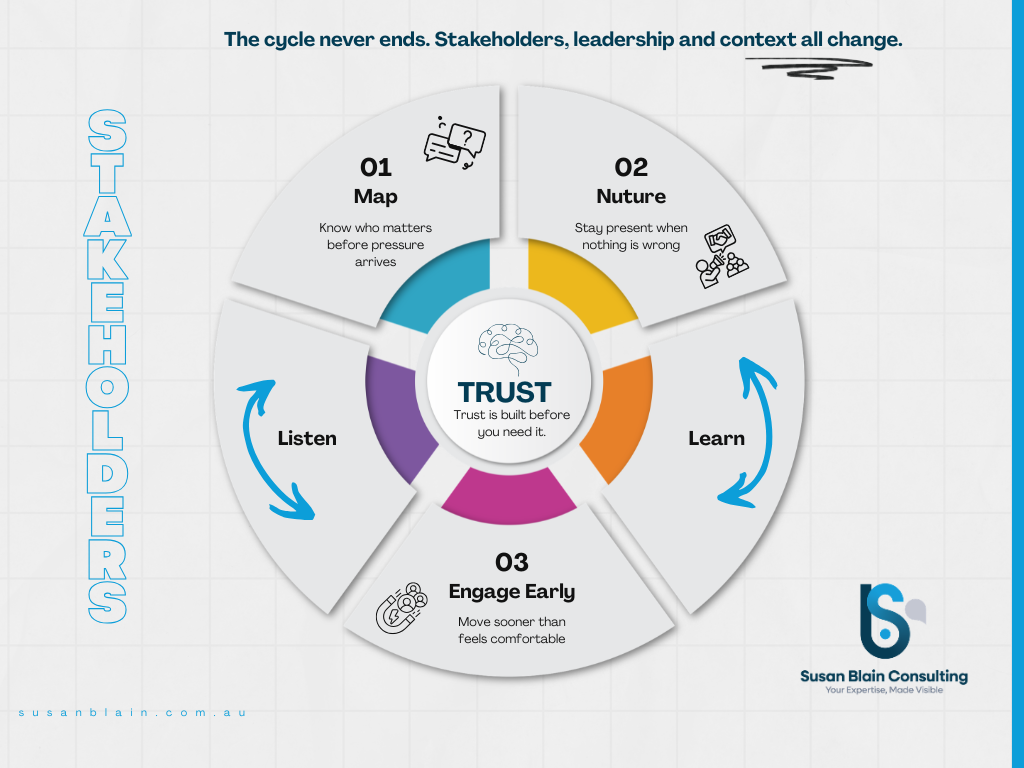
Trust is built before you need it.
Trust is built slowly and lost quickly. Stakeholder engagement is how organisations protect it, and how good leaders prove they understand the difference between managing a message and honouring a relationship.
Susan Blain has spent more than twenty years helping organisations build and sustain trust with the people who matter most to them. Her stakeholder engagement work spans professional services, health, university research and the not-for-profit sector, with a particular focus on helping leadership teams communicate through complexity, change and uncertainty.
Find out more:
Learn more about our stakeholder engagement and communications services: https://www.susanblain.com.au/services
Contact us to discuss how we can help: https://www.susanblain.com.au/contact#contact-us
Related reading: How to Create a Stakeholder Engagement Framework That Translates Complex Innovations into Commercial Partnerships
Related reading: When things feel too quiet - on the cost of going silent when it matters most
Related reading: Looking back at "abundant" times - on under-investment in communications strategy
