

Beyond the tick box: why social value reporting deserves to be told as a story

6 MIN READ
Most organisations that report on their social impact produce something earnest, forgettable and quietly embarrassing. A handful produce something people actually read. The difference is not budget. It is not design. It is whether someone took the story seriously enough to tell it properly.
I have read a lot of Corporate Social Responsibility (CSR) reports. I have written quite a few of them. And I can tell you that the ones nobody reads share the same quality: they were written by an organisation that wanted to demonstrate it cared, without quite committing to the vulnerability of showing how, or why, or what it cost them to do so.
That is the gap this article is about. Not compliance, not frameworks, not acronyms. The gap between an organisation that reports on its community impact because it has to, and one that does it because it has something genuine to say.
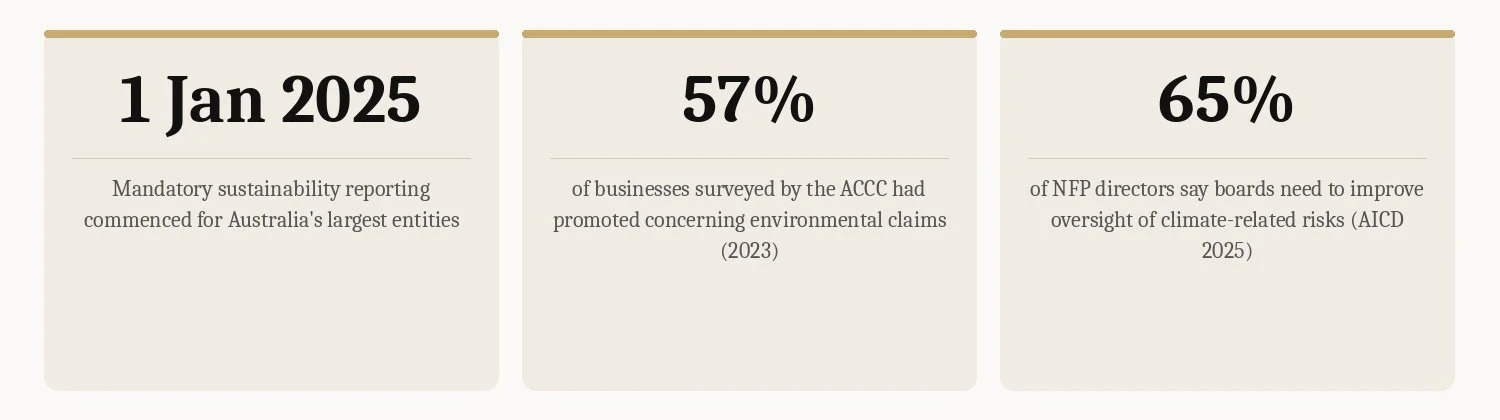
That gap matters more now than it ever has. From 1 January 2025, mandatory sustainability reporting is law in Australia. Regulators are watching. Boards are accountable. And yet the organisations that will get real value from this moment are not the ones that file on time. They are the ones that use the obligation as an invitation to tell a better story about who they are.
What the terms actually mean
CSR, ESG, Social Value, Social Impact: these terms are used interchangeably, and that confusion is not accidental. They overlap considerably. But they are not the same thing.
CSR in its traditional form was largely voluntary and largely philanthropic: a charity partner here, a volunteer day there, a well-intentioned paragraph in the back pages of an annual report. ESG is the investor and regulator-facing version: data-driven, structured, increasingly mandatory. Social Value is something more embedded still: the measurable, long-term positive change an organisation creates for the communities it operates in, not as a side project, but as a consequence of how it does business every single day.
"The best reporting does not separate what an organisation does from who it is. It treats the two as inseparable."
Australia's regulatory turning point
In September 2024, the federal government passed the Treasury Laws Amendment Bill, introducing mandatory sustainability reporting that commenced on 1 January 2025. The legislation introduces the Australian Sustainability Reporting Standards, AASB S1 and AASB S2, aligned with the International Sustainability Standards Board's global framework.
The rollout is phased. Group 1 entities are already obligated. Group 2 follows from July 2026, Group 3 from July 2027. Not-for-profit entities that meet the same size thresholds are included. ASIC has made clear that greenwashing is a top enforcement priority. A 2023 ACCC survey found that 57 per cent of 247 businesses surveyed had promoted what it described as "concerning claims" about their environmental credentials. The message for boards is unambiguous: vague, unsubstantiated impact language is a liability.
The board's responsibility
The Australian Institute of Company Directors is clear on this point: the board plays a critical function in overseeing sustainability and impact reporting. In its 2024 Not-for-Profit Governance Principles, the AICD introduced Sustainability as an entirely new governance principle, reflecting what it called "evolving community expectations and regulation on the role of organisations in society."
The AICD's 2024-25 NFP Governance and Performance Study found 65 per cent of directors believe their boards need to improve oversight of climate-related risks. A previous edition of the same study found that more than half of NFP boards reported climate change never appears on their agenda at all. The gap between intention and action remains significant, and regulators are watching.
AICD Deputy Chair Anne Cross has framed the challenge precisely: "Why do we do what we do? Do we know how change is being achieved in our organisation?" Impact reporting, done well, is the answer to that question, shared publicly and held to account.
The NFP sector: doing more with less
There are approximately 600,000 not-for-profit organisations and registered charities operating in Australia. Registered charities alone employ more than ten per cent of the Australian workforce. Seventy-five per cent of Australians donated to charity in 2024. The sector's estimated revenue for 2024-25 is $225.9 billion.
And yet 78 per cent of NFP leaders told Social Ventures Australia their organisations do not have the funding required to achieve impact at scale. Only one in four said they had the resourcing to work toward that goal. For these organisations, reporting is not a luxury. It is the mechanism by which they demonstrate worth to funders, justify grants, attract philanthropic investment and retain community trust.
The professional services problem
Professional services firms face a different challenge: articulating value that is genuinely hard to quantify. Law firms, accounting practices, consulting firms and architectural studios do not manufacture products. Their social footprint is indirect, expressed through the clients they serve, the people they develop, and the communities their offices anchor.
Writing a CSR or Social Value report for a professional services firm requires an unusual discipline: the ability to see that footprint clearly and describe it without inflating or trivialising it. It also requires the courage to be specific. The professional services sector has a tendency toward careful, hedged language. That instinct does not serve social value reporting.
PORTFOLIO CASE STUDY · CORPORATE SOCIAL RESPONSIBILITY
MV Law (formerly Meyer Vandenberg) prepared a community engagement report every year from 2013 to 2019. Each edition was built around a completely new creative concept whilst maintaining a single, recognisable identity: Red Ivy.
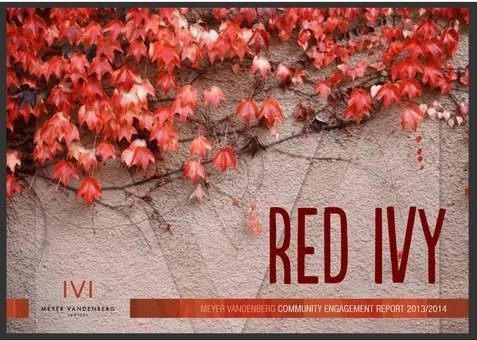
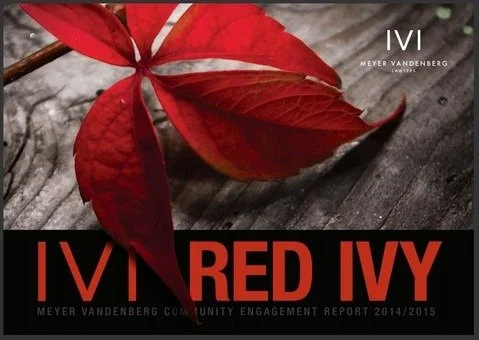

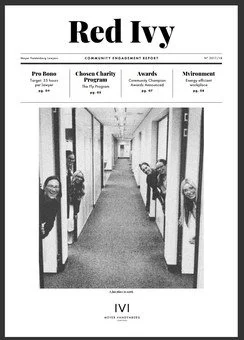
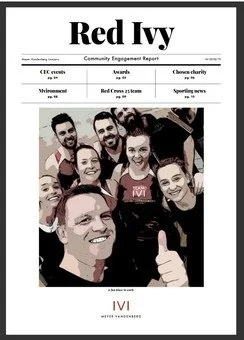
Case Study: Five consecutive Red Ivy reports, each conceived around a new creative concept: from autumn ivy, to a full movie poster, to an editorial broadsheet. The series ran from 2013 to 2019 and is a benchmark for CSR reporting in professional services.
The Red Ivy series was a genuine editorial challenge. MV Law's community work was real and substantial: pro bono legal services, school programmes, staff volunteering, and long-term community partnerships. The task was to make that work visible and vivid without reducing it to statistics, and to build a creative identity distinctive enough that stakeholders would notice, read and remember.
Year one established the foundation. Year two proved it was not a one-off. By year five, the Red Ivy report had become something that the Canberra community (and in particular clients of MV Law) looked forward to. That is a remarkable outcome for a document that did not have to exist at all.
"A reporting series that stakeholders genuinely anticipate is one of the most powerful things an organisation can build. It is proof, accumulated year by year, that the commitment is real."
The craft of telling it well
The worst social value reports are catalogues. They list initiatives, count volunteer hours, name charity partners and stop there. They are written in passive voice by someone unsure whether to be proud or apologetic, and they read exactly that way.
The best reports have a point of view. They make choices about what matters and why. They acknowledge imperfection honestly. They use data not as a substitute for narrative but as its foundation. A number without a story is a statistic. A story without a number is sentiment. The most compelling reporting holds both at once.
People comprehend through a combination: the image of a report cover, the sentence that explains what is inside, the number that grounds the claim, and the human voice that makes it real. This is not a design principle. It is a communication principle, and it applies whether the audience is a funder, a NED, a graduate recruit or a community partner.
What boards should be asking now
Does your organisation understand which regulatory reporting obligations apply to it, and by when? Is the board receiving accurate information about the organisation's social and environmental performance, not just its financial performance? Is there a named person responsible for sustainability disclosure oversight?
And beyond compliance: does the organisation have a story to tell? Not a manufactured one. A real one, grounded in actual work and actual difference. If yes, is that story being told with the care it deserves?
Organisations that treat impact reporting as a compliance exercise produce compliance documents. Organisations that treat it as an act of honest self-examination, and then find the right voice to share what they discover, produce something that lasts long after reporting season closes.

Susan Blain has spent more than twenty years writing and directing annual, community engagement and research reports across professional services, health, university research and the not-for-profit sector. Her work is benchmarked against Australasian Reporting Awards best-practice criteria. She is a member of the Institute of Community Directors Australia and the Australian Institute of Company Directors, and publishes her own CSR commitment at susanblain.com.au.
Find out more:
Annual report and CSR services: https://www.susanblain.com.au/services#annual-reports-fractional-supersub
Contact us to discuss how we can help: https://www.susanblain.com.au/contact#contact-us
More articles on annual reporting Annual Report time. The top 6 elements to an award winning annual report in Australia in 2026
Subscribe to our newsletter – Making Impact Made Easy
