

You've Identified Your High Potentials. Have You Given Them a Brand?
Supporting your superstars.
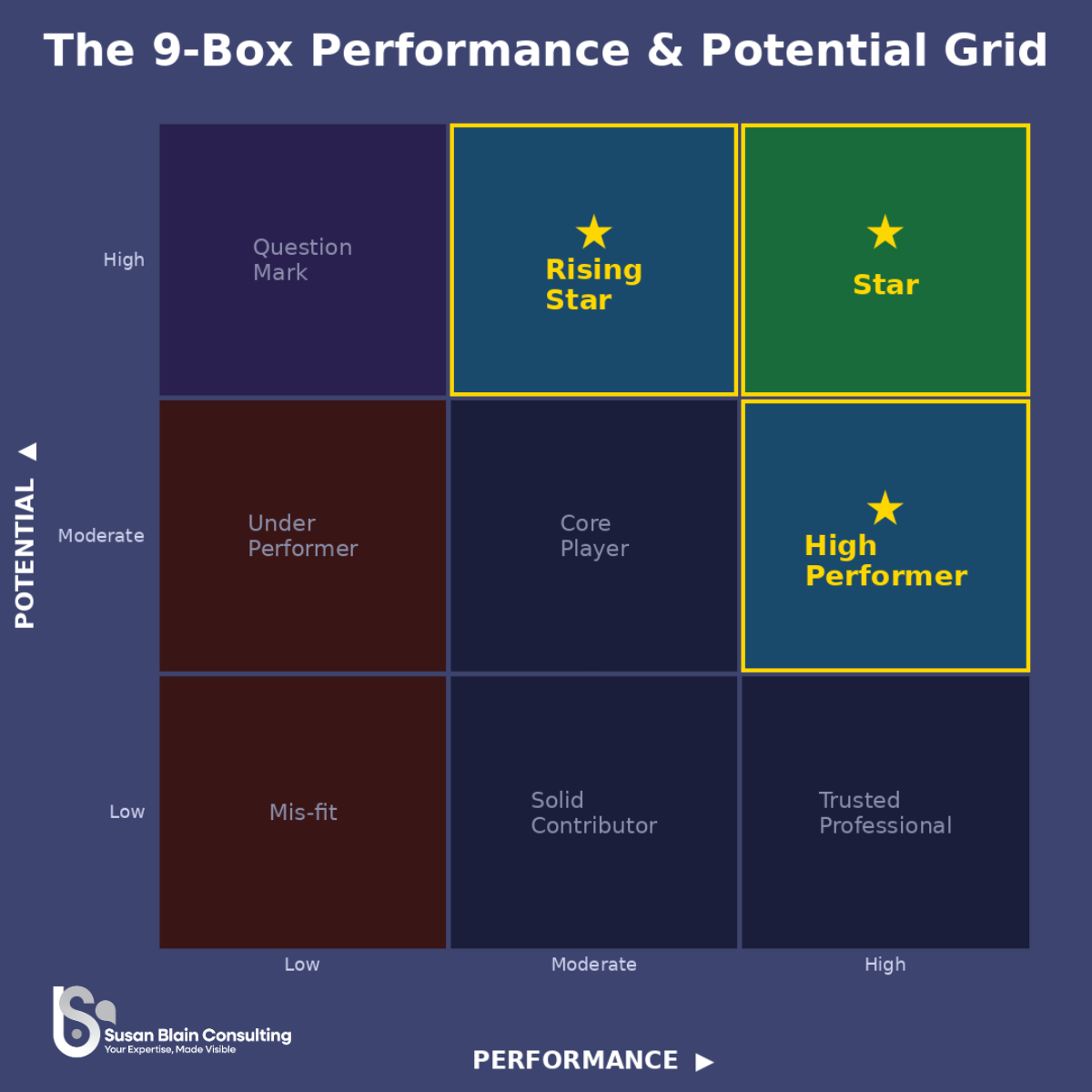
Most organisations, whether corporate, government or not-for-profit, rely on some version of the nine-box grid to evaluate their people. The grid tool, popularised by McKinsey in 1970, remains a useful framework. It helps leaders identify who is performing at the highest level and who holds the greatest potential for the future.
But here's the question I rarely hear asked: once you've identified those people, the ones sitting in the top right corner of that grid, what do you actually do with them?
Recognition matters. Reward matters. But the highest-value contribution you can make to your High Potential Employees (HiPos) is investing in what comes next for them. And what comes next is rarely more of the same.
The skills that got them here won't get them there
In my work helping HiPos define and communicate their personal brand, I see the same pattern repeatedly. These are people who have excelled by mastering a defined set of competencies. They deliver. They solve problems. They know their craft. That is precisely why they've been identified as stars.
But the next chapter of their career is written in an entirely different language. Technical excellence alone does not translate into leadership identity. And leadership identity, crucially, is not something that develops by default. It has to be shaped, articulated and expressed with intention.
Many HiPos reach this threshold and find themselves unexpectedly uncertain. Not about their ability, but about how to present themselves in this new register. That is not a failure. That is a branding challenge.
What a branding specialist can do that a leadership consultant cannot
I work with HiPos at precisely this inflection point, helping them understand and articulate who they are as leaders, not whom they should become. The capability is already there. What's often missing is the clarity and confidence to express it.
That means helping them identify their genuine leadership voice. It means understanding which communications channels are available to them and how to use each one with purpose and authenticity. And it means building a personal brand that is symbiotic with their current organisation while remaining distinctly and sustainably their own.
The best HiPos I work with are not just assets to their employer today. They are consciously building a professional identity that will carry weight in their sector, their department or their wider community for years to come. That longer view is part of what we work on together.
For HR teams and senior leaders
If you are responsible for performance, talent or people development, and you are using tools like the nine-box grid to identify your HiPos, I'd invite you to consider what your retention and development offer looks like for those individuals once they've been identified.
Spotting talent is one thing. Giving your HiPos the tools to grow into the leaders your organisation needs them to become is another. Personal brand development is one of the most overlooked and most impactful investments you can make at this level.
If that resonates, I'd welcome a conversation.
Let’s Work Together | Book a conversation More Ideas | Explore related articles | Services
Subscribe to Making Impact Made Easy
